

RM-10®
Clay-Based Flocculant
CETCO provides a comprehensive line of world-renown RM -10 clay-based flocculants. These granular, semi-granular, powdered and liquid varieties are formulated to treat a vast array of industrial and municipal wastewater. The RM -10 products are a non-hazardous blend of naturally occurring bentonite, pH adjusting agents, polymers and other exclusive components.
Applications
One-step removal of emulsified oil, heavy metals and suspended solids from wastewater streams
Applications & Basic Mixing Instructions for
All Listed Dry Formulations
- Fill reaction vessel with wastewater and start mixer
- 2-3 minutes; observe large floc forming
- Stop mixer and allow floc to settle for 3-5 minutes
- Start mixer and mix for approximately 30 seconds
- Stop mixer and allow floc to settle for 3-5 minutes
- Open effluent valve to allow clean water to pass through filter media
- Open sludge valve to allow solids to be filtered over filter media and further de-watered
- Clean water is collected and typically discharged to Publicly Owned Treatment Works (POTW) or recycled back into the process
- De-watered solids collected for disposal at local land fill
Features & Benefits
- System meets POTW discharge limits various particle sizes
- Lower overall costs
- Treat onsite
- Dry chemical versions for easy storage, movement and minimal dusting
- Decreased process time
- Versatile technology with consistent results
- Safe and cost-effective mean of treatment and disposal for various wastewater streams.
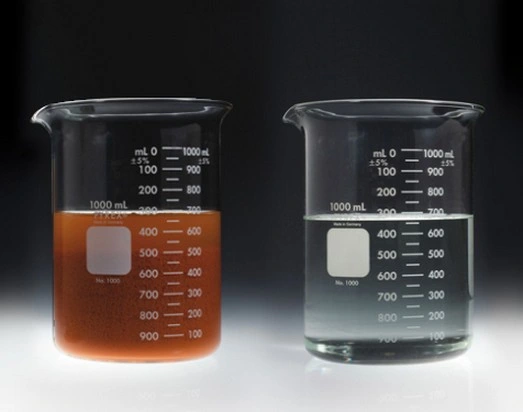
How RM-10 Treatment Works
Chemical components adjust the pH of the water to enhance the precipitation
of metals and breaks oil emulsions.
Bentonite clay particles attract and encapsulate precipitated metallic ions.
The polymeric portion of the formulation attracts remaining oils and suspended
solids then forms a floc, which settles to the bottom of the treatment vessel.
The bentonite clay and polymer work together to create a strong filterable floc,
which will encapsulate and contain heavy metals through a pozzolanic reaction
while allowing the floc to readily release water resulting in a drier sludge cake.
The entire process is completed in just a few minutes, resulting in clear water
that can be discharged directly to a POTW or recycled.
The sludge and its encapsulated contaminants are highly resistant to leaching
and can be generally disposed of as a non-hazardous waste.
In Canada, the exact formulation of CETCO RM-10 clay-based flocculants is determined through bench-scale jar testing of a representative wastewater sample. Because CETCO produces more than 40 different RM-10 blends (varying in pH adjusters, polymers, and particle size), there is no single universal formula; instead, a Canadian distributor or technical lab matches the blend to your specific waste stream and local discharge bylaws.
Step-by-Step Selection Process
- Sample Collection: You collect a representative sample (typically 1 to 5 litres) of the raw industrial wastewater under normal operating conditions.
- Bench-Scale Jar Testing: An authorized Canadian water treatment distributor runs jar tests using several candidate RM-10 formulations (e.g., RM-10 2001 through 2025+).
They evaluate:
- Contaminant profile: Types of emulsified oils, heavy metals, inks, paints, or suspended solids present.
- pH adjustment needs: Whether the wastewater needs an acidic, neutral, or alkaline blend (different RM-10 formulations range from a pH of ~2.4 to 12.0 in dispersion).
- Floc formation and settling speed: How quickly the clay and polymer bind the contaminants into a filterable floc.
- Filtrate & Sludge Verification: The treated water (filtrate) from the top-performing jar test is analysed to verify it meets local Canadian municipal sewer-use bylaws or provincial discharge limits.
- Dosage & Equipment Matching: Once the formulation number is locked in, the lab establishes the exact dosage rate (typically measured in grams per litre or pounds per gallon) and matches the physical form (powder, semi-granular, or granular) to your chemical feeder and filtration setup.
In the Greater Vancouver Regional District (GVRD / Metro Vancouver), the specific RM-10 formulation is determined by jar testing your wastewater against the discharge limits set in GVS&DD Sewer Use Bylaw No. 299 (or your specific municipal sewer bylaw if you are within the City of Vancouver).
1. Target Compliance Benchmarks (Metro Vancouver) h
During bench-scale jar testing, the lab or distributor selects an RM-10 blend (such as RM-10 2001 through 2025+) that brings your treated filtrate below Metro Vancouver's Restricted Waste limits. Common targets include:
- pH: Must finish strictly between 5.5 and 10.5 (this dictates whether you need an acidic, neutral, or alkaline RM-10 blend).
- Total Suspended Solids (TSS): Under 600 mg/L.
- Oil & Grease: Under 15 mg/L for hydrocarbon oil & grease, and under 150 mg/L for total oil & grease.
- Heavy Metals: Must meet strict total metal caps (e.g., Copper ≤ 2 mg/L, Lead ≤ 1 mg/L, Cadmium ≤ 0.2 mg/L, Chromium ≤ 4 mg/L).
2. Local Testing & Permitting Steps in GVRDb
- Distributor Jar Testing: Reach out to a Western Canadian industrial water treatment supplier or directly to CETCO Water and Remediation to arrange a bench test. You will ship them a 1–5 L sample of your raw effluent so they can test multiple formulations and provide a dosage rate.
- Independent Lab Verification: Before discharging, you will typically send a sample of the RM-10 treated filtrate to a CALA-accredited Lower Mainland lab (such as ALS Environmental in Burnaby or Caro Analytical in Richmond) to prove compliance with Schedule B of Bylaw 299.
- Waste Discharge Permit: If your facility discharges high volumes or regulated industrial waste, you must submit your treatment process details and lab results to Metro Vancouver's Liquid Waste Regulatory Program to obtain or amend a Waste Discharge Permit.
- Sludge Disposal (BC Hazardous Waste Regulation): The settled clay floc must pass a TCLP (Toxicity Characteristic Leaching Procedure) test to confirm it qualifies as non-hazardous solid waste for local disposal under BC's Hazardous Waste Regulation.
| Technical Specifications | |||
| Formulation # | Particle Type | Bulk Density (lbs./ft³) | pH (5% dispersion) |
| 2001 | Semi-Granular | 30 - 40 | 5.5 - 6.5 |
| 2002 | Semi-Granular | 42 ± 2 | 5.5 - 6.5 |
| 2003 | Semi-Granular | 45 - 55 | 6.5 - 7.0 |
| 2004 | Semi-Granular | 55 ± 2 | 6.5 - 8.5 |
| 2005 | Powder | 66 ± 2 | 2.5 - 4.5 |
| 2006 | Semi-Granular | 70 ± 2 | 3.0 - 4.0 |
| 2008 | Semi-Granular | 70 ± 2 | 2.5 - 4.5 |
| 2009 | Semi-Granular | 70 ± 2 | 2.5 - 4.5 |
| 2013 | Semi-Granular | 70 ± 2 | 8.5 - 10.5 |
| 2014 | Semi-Granular | 70 ± 2 | 2.4 - 4.5 |
| 2015 | Semi-Granular | 70 ± 2 | 4.0 - 6.0 |
| 2017 | Powder | 70 ± 2 | 10.0 - 12.0 |
| 2018 | Powder | 66 ± 2 | 2.5 - 4.5 |
| 2019 | Semi-Granular | 70 ± 2 | 6.5 - 8.5 |
| 2020 | Semi-Granular | 70 ± 2 | 3.0 - 4.0 |
| 2021 | Semi-Granular | 70 ± 2 | 3.0 - 5.0 |
| 2022 | Semi-Granular | 70 ± 2 | 2.5 - 4.5 |
| 2025 | Semi-Granular | 70 ± 2 | 2.5 - 4.5 |
| 3001 | Granular | 62 ± 2 | 8.5 - 10.5 |
| 3204 | Granular | 62 ± 2 | 8.5 - 10.5 |
| 4001 | Semi-Granular | 70 ± 2 | 6.5 - 8.5 |
| 4003 | Granular | 70 ± 2 | 3.0 - 5.0 |
| Technical Specifications | |||
| Formulation # | Particle Type | Bulk Density (lbs./ft³) | pH (5% dispersion) |
| 4004 | Granular | 70 ± 2 | 4.0 - 6.0 |
| 4005 | Granular | 70 ± 2 | 6.5 - 8.5 |
| 4006 | Granular | 70 ± 2 | 3.5 - 5.5 |
| 4007 | Granular | 70 ± 2 | 6.5 - 8.5 |
| 4008 | Granular | 70 ± 2 | 6.5 - 8.5 |
| 4009 | Granular | 70 ± 2 | 3.0 - 4.0 |
| 4010 | Granular | 70 ± 2 | 3.0 - 4.0 |
| 5001 | Granular | 65 ± 2 | 2.5 - 4.0 |
| 5002 | Semi-Granular | 70 ± 2 | 3.0 - 5.0 |
| 5004 | Granular | 65 ± 2 | 2.5 - 4.0 |
| 5005 | Semi-Granular | 70 ± 2 | 3.0 - 5.0 |
| 5006 | Granular | 65 ± 2 | 2.5 - 3.5 |
| 5007 | Granular | 65 ± 2 | 2.5 - 4.0 |
| 5008 | Granular | 65 ± 2 | 2.5 - 3.5 |
| 5009 | Granular | 65 ± 2 | 2.5 - 3.5 |
| 5010 | Granular | 65 ± 2 | 2.5 - 4.0 |
| 5011 | Granular | 65 ± 2 | 2.5 - 4.0 |
| 5012 | Granular | 65 ± 2 | 2.5 - 4.0 |
| 5501 | Granular | 65 ± 2 | 2.5 - 4.0 |
| 6001 | Granular | 65 ± 2 | 2.5 - 4.0 |
| Eveready | Powder | 70 ± 2 | 5.5 - 7.5 |
| NS121 | Semi-Granular | 70 ± 2 | 7.5 - 9.5 |